Showing posts with label Education. Show all posts

Thursday, 12 November 2015

Top 5 most important things you MUST do for P1 Orientation

Top 5 most important things you MUST do for P1 Orientation


It's orientation day!
Image result for orientation day minions
(Source)

If your first born is entering P1 next year, it must be an exciting time for you and your child. Well, I was feeling exactly the same 2 years ago when my first born enters Primary School. 

You must be looking forward to Orientation Day. But there are a few important things that you must do for that day and on that day. 

Top of the list, 

1) Prepare your child to give an introductory speech. 
Your child will be ushered into his/her new class while you stay in the hall for the talk. During his/her time in class, the teacher will get each child to introduce themselves to the classmates. So, don't go unprepared. Just a very simple one will do. 

For example, 

" Good morning/afternoon teachers and friends. My name is ___________________. I love playing with trains. I am so excited to be in Primary School. I hope to make some friends and have fun learning together with all of you. Thank you. 

In some schools, the children are asked to do a simple worksheet. Reassure your child that there is no stress about it. The teacher just wants to find out about your child as much as they can during this short time. 


2) Remind your child to make friends with at least 3 classmates and remember the 3 names. 

Being in a new environment and with so many strangers around can be a little overwhelming for your child. But your child has to seize this opportunity to make friends. Being through school ourselves, we all know how important friends are. Having friends means having support and help in the future for your child. So simply, ask your child to do the following: 

a) Approach someone (during the interaction time).
b) Introduce yourself again by stating your name. 
c) Ask for the person's name.

" Hello. ( Perhaps, teach your child how to initiate a handshake?) I'm Emmanuel. What's your name?  Nice to meet you. " Or the more kiddy way, like my son would say "Let's be friends".


3) Parents, make friends yourself and get some of their handphone numbers. 

Ensure that you get to know the other parents from the same class. This will form your support circle for the next 2 years. In most schools, parents of the same class will be ushered into a class to complete the administrative work. Use the opportunity to get to know other parents and most important, get some of their handphone numbers. Don't be afraid to ask, because there are many of them who will be eager to get yours too. 

You can consider setting up a parents' chat group. 

In my daughter’s school, during orientation, we will elect a parents’ representative and he/she is in charge to creating a whatsapp group to include all the parents in class. I find it very useful as it is so much easier for us as parents to clarify things or communicate with other parents. Also, if your child is absent, you can even check what homework there are for the day.

However, you need to be cautious when having such group. Don’t let the group be changed into a group which is negative, which constantly complains about everything in school.

Luckily for me, the parents' chat group have been very supportive and is an important source of information. 


4) Bring your child and visit the General Office. 

The first month of school can be very very eventful. Your child might miss the school bus, lose the wallet or forgett to bring money for recess. So, it is important for your child to know where to get help. Hence, bring your child and tell him/her that this is the place where they are seek help from. Ensure them that the General Office will render them any help that they need. 

Staff Room is another alternative. However, in the first few weeks, your child might still be confused over "who is who" and may not even remember the name of the form teacher. There could be a few " Mrs whatever" in school. So, General Office is the most direct place for me. 

This is what I will tell my child.

" This is the General Office. You need to remember this place. If you ever need any help, come to the General Office and someone will help you. Don't be afraid to ask for help. The General Office has Mummy and Daddy's number. They will call us if there is anything urgent. So, remember to come to the General Office for help."


5) Check out the canteen food and prices. 

When school starts, you may not have a chance to visit the school canteen anymore. In most schools, parents are not allowed to enter school during school hours. In some schools, you may visit your child during recess time during the first 3 days, but you might not be able to get to your child in the canteen. 

Thus, during orientation day, visit the school canteen and check out the prices. This will help you to determine how much pocket money you should give to your child. 

Usually, there are 2 portions for canteen food, small and big. Check out how much the small/big portion cost. Check out the drinks stall and then calculate how much money your child needs for a meal. 


If you find this article useful, do share. 

Join me on Facebook, SG Primary School Parents and get connected to other parents or ask questions about Primary School. 

Join me on my page, Raising Our Successful Children to get ideas for fun activities that you can do with your kids. 

Other Articles on Education

Tuesday, 3 November 2015

Stickerkid Review and 10% Discount {Sponsored}


                                                                   {Sponsored}


Time flies!!! 
Faith will be going to Nursery 2 and Emmanuel will enter Primary 1 next year.

The fascinating thing is that Faith is starting to worry about me being alone. 

Faith: " Mummy, next year I'm going to school already. Yeah!!( in excitement). Then Jie Jie and kor kor will go to their school. Then Mummy, you are very poor thing. When I go to school, you got no baby to look after already. But never mind, you just go shopping or go lunch or stay at home and watch your show. When I'm done, you come and fetch me. Then I'll be home with you again ok? I will go to school and come back quickly. You don't worry ok? "


They are growing up so fast. 
Anyway, back to the main point, I am starting to get them ready for school next year. Last year, I wrote an article " Useful Tips for Preparing for Primary School" and the its first tip is to have personalised name labels for books and personal items. 

This year, I'm so happy that Stickerkid provided us with the name labels for Faith and Emmanuel. After trying out the product for one month, these are the reasons why I would recommend Stickerkid. 

1. Ordering is as easy as ABC

a) The ordering process took less than 10 mins of my time and it was hassle free. Hassle Free....this is seriously an important point for me because this means I don't have to bring 3 monkeys..opps.. I mean kids, physically down to the shop that I used to buy these name labels from and try to select the design I have, and then, struggle to write down the names I want printed on the stickers. Well, parents,  you perfect know what I mean and I don't have to elaborate. So yes, ordering online is as much easier. 

b) Moreover, the website is super user friendly (Click to enter Stickerkid official site).

All you need to do is: 


  • Select the pack that you want. 
  • Type in the name you want printed on the stickers.
  • Select the colour and the font for it. 
  • Click Order and then pay for it. 


That is it. Simple and Easy.  

Getting the kids involved is easy as well, as they just needed to tell me what colour they want and the "logo" (cartoon picture) that they would like on the sticker. Of course, Emmanuel chose his favourite animal, the Penguin. 


2. Fast Delivery
What is even better is that the delivery was like super fast. I really don't know exact how fast they were. But the stickers were in my letterbox the next time I collected my mails right after my order. I was really impressed with the speed that I received these stickers. Previously when I ordered from the shop, I had to wait for 1-2 weeks to collect the name labels. So, this is really really fast.. 


3. Value for Money 

We are always looking for things that are good and value for money. Aren't we? I would think that stickerkid is good and affordable. Considering the fact that it saved me a lot of time and it was hassle free. But there are 2 packs that I find it most value for money. 

The first one is a basic pack of 94 stickers pack for just $19.95. It consists of 60 small name labels, 14 shoe stickers and 20 clothing stickers. If you are trying stickerkid for the first time and just want to test out the quality, this is the basic pack for you. Below is the link for you.


The second one is "My First Pack" of 154 stickers for $49. It consists of 32 large stickers, 14 shoes stickers, 60 small stickers and 48 clothes stickers. For more information, you can check it out at http://www.stickerkid.sg/sg_en/my-first-pack-kindergarten-stickers-labels-clothes-shoe.html


4. The stickers are very useful and attractive.


At Stickerkid, you can find stickers of different function. 
They have the basic name labels for items such as water bottles, pencil case, etc... They also have shoes stickers and clothes stickers. It comes it different sizes as well. You can even print the photo of your child on the sticker. Perhaps, for preschoolers, seeing their own photo will be the best way to identify their items.

Well, for me, I didn't even think of shoes and clothes stickers. I have previously just used fabric marker to label my eldest daughter's uniform and shoes. But now, I can just iron on the clothes stickers for my son and stick the shoes stickers on. It saves me time again. For all mummies, you know how important saving time is. We all have 24 hours and with kids, time is never enough. 

When the stickers arrived and I opened up the mail, my kids rushed to me because they saw that I was looking at something interesting. The colour and cartoon was what attracted them. The colour of the stickers were very bright and very attractive. Moreover, it has my son's favourite penguin inside. In fact, he doesn't want me to use those stickers and asked if he can just keep them. That is how attractive the stickers are. 

Faith is happy to label her belongings.


5. Quality of the stickers 
For me, quality is important. I took about a month to write this review because I want to try out the product before recommending it to other parents. I must say that the quality is impressive. As I have used other name labels before, I can confidently say that the quality of stickerkid is much better. When I peeled off the first sticker, I can already feel the difference. The label is not made of normal sticker material. Instead it is malleable and flexible. I can stretch it a little as well.

For me, I decided to put those stickers to test. I only ordered the name labels for Faith, but her schoolbag for next year is made of fabric. So, I decided to test if those normal name labels (not clothes stickers) can be used on her fabric schoolbag. To my pleasant surprise, it stuck very nicely and is still there after a month. 

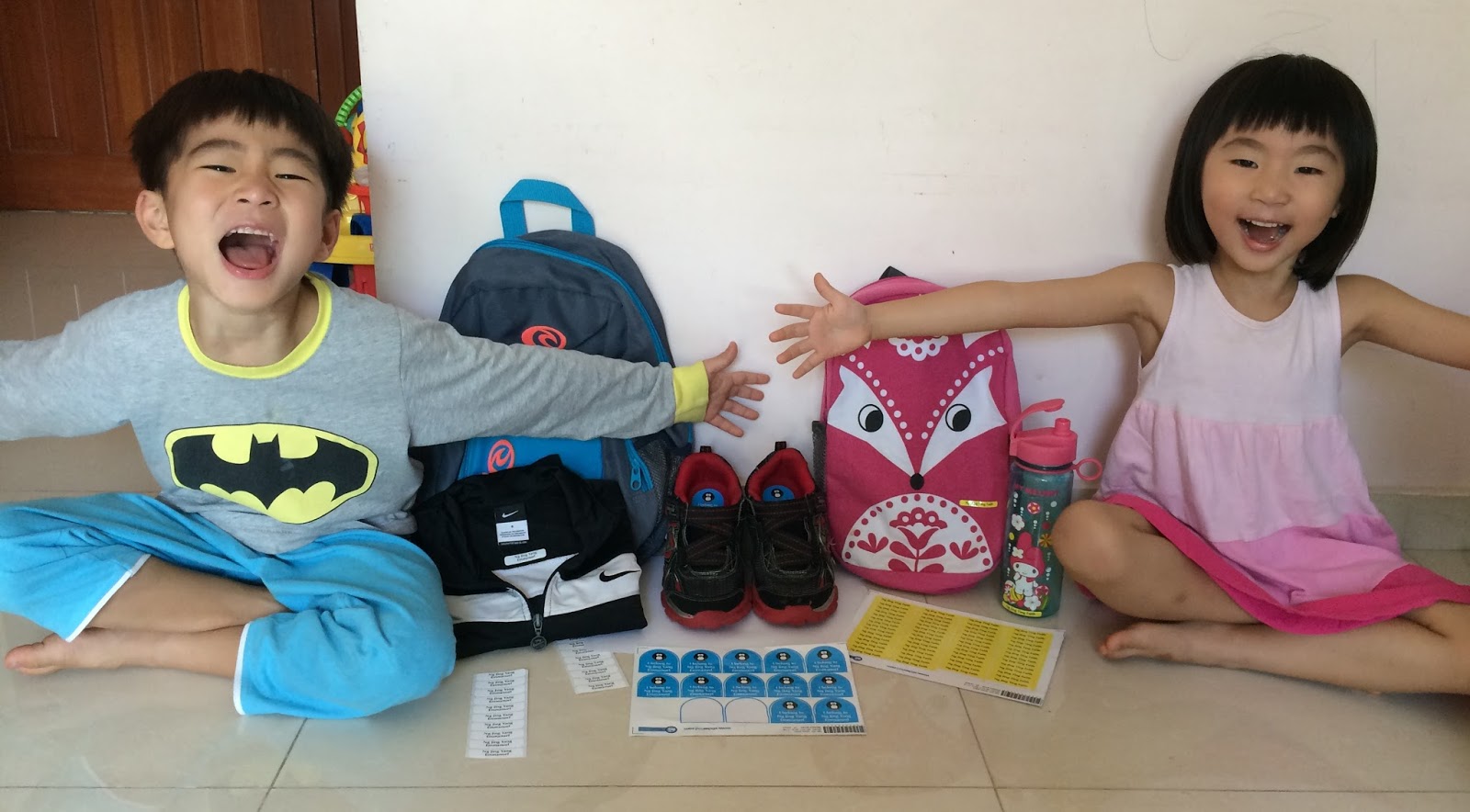
To test the product even further, I use the sticker meant for clothes and iron it onto Emmanuel's school bag for next year. And it works too. 


Ironing on the fabric sticker onto Emmanuel's jacket is so easy. I simply set the iron to the heat for wool, I place a small sheet of baking paper above the sticker and iron it on. I took less than 10 seconds for it to stick. So easy.


For those shoes stickers, I have finally persuaded Emmanuel to try it out on a pair of sports shoes that he is wearing. 


Overall, we are satisfied customers. Just look at the smile on their faces. 


 I will order more of these stickers for my kids. 

Try stickerkid today and get at 10% discount from here. 

Get your stickers today and key in the 10% discount promotional code: 

SG10STICKERKI3_X2

This 10% discount is only valid till the end of this year (31 Decemeber 2015). So, do it fast..

I hope you find this post useful.
Join me on facebook at Raising Our Successful Children  or SG Primary School Parents for more updates. 


Monday, 5 October 2015

Simile

Simile: A simile is a direct comparison between two unlike things.

Simile can be useful to describe people or things during writing. 

Natalie was doing a worksheet on this and I decided to compile a list for her for easy reference. 


As fat as a pig

As crafty as a fox

As timid as a mouse

As wise as an owl

As loud as thunder

As white as snow

As proud as a peacock

As colourful as a rainbow

As cool as a cucumber

As graceful as swans

As fast as a hare

As brave as a bear

As big as an elephant

As black as coal

As blind as bat

As busy as a bee

As clear as crystal

As easy as ABC

As fresh as a daisy

As gentle as lamb

As heavy as lead

As innocent as a lamb

As light as a feather

As playful as a kitten

As quick as lighting

As regular as clockwork

As stiff as a board

As stubborn as a mule

As sweet as pie

As tall as a giraffe

As agile as a monkey

As slow as a snail

As mad as a hornet

As quick as silver

As sick as a dog

As silent as the grave

As tough as old boots

As white as a ghost

As alike as two peas

As delicate as a flower

As silly as a goose

As free as a bird
  

Simile- Lenka's song-"everything at once" is useful for teaching simile.
As mean as a wolf
As sharp as a tooth
As deep as a bite
As dark as the night
As long as a road
As ugly as a toad
As hard as nails
As grand as a whale
As cold as ice
As old as time
As stealthy as a tiger
As sly as a fox
As strong as an ox
As neat as a word
As quiet as a mouse

As big as a house

Tuesday, 22 September 2015

Revision Strategies

Revision Strategies


Learn, Practice, Review

Revision consists of 3 stages – Learn, Practice, Review.


Stage 1: Learn

There are many different types of learning methods. The most basic is to read the information. Reading here refers to intensive reading and not skimming or scanning. Intensive reading means to pick up information/concepts/keywords.


Good Studying Habits

Highlighting keywords/important information/ concepts is always useful. Use different coloured highlighters to make the informative attractive and interesting. Highlight words that you don’t understand (reserve red highlighter for this purpose). This applies to all the subjects. Even for Mandarin, she highlights key phrases and new words for every chapter. Natalie would then write down the meaning next to those key phrases or new words.
Highlighting keywords that she needs to learn and writing down its meaning. 

An example of her making her own notes on the textbook. 


Write down your question on the page immediately and tab it or write it on a post it and stick it on the page.  Many a times, students come to me and say that theyhave a question for me. But by the time they want to ask, they have already forgotten what their question is about. So, don’t just “think you can remember your question”. Write it down immediately.

But reading may not translate to learning. Hence, for some children, they will need to summarize what they have learnt, depending on their learning style (Click to read on the different learning styles).

Suggestion:
  • Visual Learners: Mindmap ( draw/use different colours/shapes) *Natalie is a more linguistic learner and hence, I have not yet done any mind-mapping with her. 


  • Linguistic Learners: Notes ( point form/ paragraphs)


An example of notes for Mathematics Model drawing. I'm keeping the example question real simple so that she can concentrate purely on the concept.
  • Verbal – Linguistic Learners: Read aloud


  • Mandarin - "Ting xie" will be given for all key phrases and new words for all the chapters. By writing all the key phrases and new words out for each chapter, she is in fact consolidating her learning. This becomes her consolidated revision list. However, it is made clear to her that at the learning stage, she shouldn't be afraid to make errors because this is the part where she should be learning.


Summarizing is always good as a revision strategy because it means that you don’t have to read through all the informative again. All you need to do is have a good summarized version and it can be used for mid year examination and then again for end of year examination. Do the work once, then maximum the use.


Stage 2: Practice

There are 2 types of practice – formative and summative.

Formative practice means to do as a means to find out “what you know and what you don’t know”. This form of practice aims to achieve subject mastery. Doing assessment books is a form of formative practice. The focus is the learning process. 
(*Tip: avoid studying with music/ with the television on at the background. Some kids get so used to the noise that they feel uncomfortable/restless during real exam condition.)

Summative practice means to do a test/exam paper in an exam condition (to finish within a given time). This form of practice aims to train stamina, concentration and most importantly, time management and other exam skills under examination conditions. The focus is to test how much the child can achieve.

Summative practice is important because there are kids who can perform under normal circumstances but fails under examination conditions as they lack stamina/concentration/time management/ exam skills. Hence, it’s important to get the child to get used to examination condition while doing summative practice. 

For instance, what do you do if there is a difficult question that you can't solve? There are real instances where a child continues to attempt one difficult question and ends up not being able to finish the rest of the paper. 

These skills have to be taught to the child, especially if the child is in lower primary. Some kids just cannot sit there for 1.5hrs or even for an hour. Most kids will be sleeping during exams. Even though, the teachers will constantly wake the child up should he be sleeping during the paper, there is nothing the teacher can do if your child chooses to go back to sleep again. 

*Tips on doing the paper.

Usually, I write down the duration taken for Natalie to complete round 1 of the paper and the duration of her checking the paper as well. This helps with time management.

It is obvious that during her first attempt at the paper, she completed the paper too fast and hence, she can learn to slow down.


Secondly, for round 1 of doing the paper, it is done in pencil. For checking, I will ask her to use a blue pen to make changes. In this case, I can track the number of errors that she spotted or the changes that she have made. Checking is challenging for the child, so practicing how to check is essential. By making the child use pencil first and then blue pen for checking, it is easier for us to follow their train of thoughts. I encourage Natalie to redo all the questions and then check against the final answer.


Highlighting key words on the exam paper is a good practice that will keep the child focused on what he needs to do. 


Simulating Examination condition at home.
a)  A quiet, conducive environment.
My girl will be seated alone at the table to do her paper while her sibling will be inside the room with me. This reduces noise and movement around the house. I will check on her every 15-30mins. The air conditioner is also off because there will not be air con under real exam condition. So she better get used to the heat and being seated her doing her papers.

b) Only toilet breaks are allowed.
There will be no food or drinks during the paper. Even toilet breaks are cut to the minimum. For an hour paper, she understands that there can only be 1 -2 toilet breaks.
 (* You will be surprised that under real examination condition in school, some kids will constantly go for toilet breaks due to nervousness or boredom.)


Stage 3: Review

Reviewing the errors, also known as corrections. 
For mathematics, one effective way of doing corrections is to redo the whole question again. But most of the time, I will do a quick analysis of the errors and find out "what went wrong?". Is it that she doesn't understand the concept or what the question means or just pure calculation error. 

If it's just pure calculation error, it's simple, just count it again. But if it's the concept or the question that she doesn't understand, I will go through step by step with her again. Clarify all her doubts and then look for similar questions (at least 5-10 questions) for her to practice, just to make sure that she truly have learnt. 


For English, if it's a new vocabulary word, I will make her write out the word and its meaning in her vocabulary notebook. She has a notebook to record new vocabulary and form of words in the different tenses. She practically have a notebook for everything. 

For Mandarin, she will have to rewrite the words/sentence and I will test her on the meaning of the the words/sentences before asking her to attempt similar questions again. 

Reviewing repeatedly
Repetition helps one to transfer the information from our short term memory to our long term memory. Moreover, repetition can deepen understanding. Hence, reviewing the information regularly is equally important. 

Finally, revision is about “quality learning, not about quantity”. Some children can practice a lot and learn very little. Use the errors as a form of feedback of what the child doesn’t understand. Go beyond just the question. Look at the concept the question is actually testing.


"An error remains an error as long as you learnt it. It only becomes a mistake if you commit the error again. So learn from the errors and don’t let them become a mistake."